

Dentures Dallas
The Tried-and-True Path to a New Smile

If you, or someone you care for, are struggling with tooth loss, then you know all too well how difficult it is. From smiling confidently to enunciating clearly, everyday things are significantly harder. The good news is that there is a solution: dentures. This tried-and-true tooth-replacement option has been used for decades, and our team at Casper Family Dentistry of Dallas can make a denture for you that looks and feels like the real thing. If you want to learn more, then read on or give us a call to schedule a consultation!
Why Choose Casper Family Dentistry of Dallas for Dentures?
- Custom-Made Restorations
- In-Network with Most PPO Dental Plans
- Convenient Hours, Including Saturdays
Who Is a Good Candidate for Dentures?

If you are missing several teeth – whether it’s due to gum disease, a sports-related injury, or something else entirely – there’s a good chance that dentures are an option for you! In fact, this tooth-replacement solution has helped countless patients over the years, including those who don’t have any of their natural teeth left. So, if you are missing a few teeth in a row, all of your molars, or several teeth throughout your mouth, don’t hesitate to schedule an appointment with us to find out if you’re a candidate.
Types of Dentures
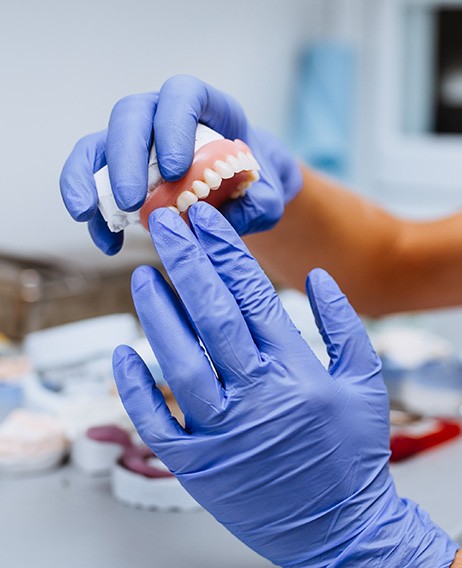
Although they are usually referred to as simply “dentures,” there are actually three different types: partial, full, and implant. You can learn more about each below, but we will review them more in-depth during your appointment. That way, you can feel confident deciding which one is right for you.
Partial Dentures
If you still have a few (or almost all) of your natural teeth, then we want to preserve them while filling the empty spaces in your smile. That’s where partial dentures come in. With a discreet metal clasp and a gum-colored base, this tooth-replacement option seamlessly restores the look and function of your smile.
Full Dentures
If you are missing all of your teeth, don’t fret – that’s what full dentures are for! Like partial dentures, full dentures have a gum-colored base to add to their lifelike look and feel. They remain in place with natural suction or a special adhesive, so there aren’t any metal components either.
Implant Dentures
Dental implants have skyrocketed in popularity for several reasons, including the fact that they stimulate your jawbone to prevent bone loss. Now, dental implants can be used to secure your denture in place, making them last longer than ever before. Contact us today to find out if implant dentures are right for you.
The Benefits of Dentures

Millions of patients have chosen to restore their smiles with dentures because:
- They are custom-made
- They are cost-effective
- They can last for 10 years or more
- They can restore the strength of your bite
- They can improve your self-esteem
- They are easy to care for
Denture FAQs
What’s the Average Age for Getting Dentures?
Many people near Dallas associate tooth loss with aging because it tends to affect older adults more frequently. For example, and estimated 33% of adults between 20 and 39 are reported to have at least one missing tooth compared to nearly 66% of those who are between 40 and 64 years old.
But tooth loss can potentially impact people of any age at any point in their lives, and there’s no age restriction or limitation on when you can get dentures. Many younger adults suffer tooth loss due to periodontitis (advanced-stage gum disease), severe tooth decay, or physical trauma that dislodges one or more teeth, and require a restoration.
Can I Sleep with My Dentures In?
Plenty of patients are curious if it’s safe or acceptable to sleep with their prosthetics in place, and while it might not cause harm if it happens once or twice, it’s usually not recommended. This is because your dentures form a tight suction against your connective tissues to remain in place throughout the day, which reduces their circulation. This can cause sores to develop, increase inflammation, or contribute to gum disease or other concerns.
It’s usually better to remove your dentures to thoroughly wash them, then leave them to soak in a glass of room-temperature water or a special cleaning solution overnight to kill germs and maintain their shape while your mouth gets to rest and recover while you sleep.
Is It Hard to Talk with Dentures?
It often takes patients about a month to fully acclimate to their new dentures, and it’s possible to develop a temporary lisp or clicking sound until your tongue and the other sensitive tissues in your mouth adjust. Thankfully, this side effect is usually temporary and resolves on its own in time.
You might be able to speed up this transitional period by using denture adhesives, which form a layer of cushion between your gums and the foundation of your restoration to improve their bond and comfortability. You might also rehearse different words by reading out loud to yourself or recording yourself, then practicing challenging sounds until you feel more confident in your enunciation.
Why Do My Dentures Smell?
Have your dentures developed an unpleasant smell or taste that you can’t seem to overcome? This sometimes happens when bacteria in your mouth are able to thrive and form plaque on the surfaces of your new teeth. These germs release foul-smelling gasses, such as hydrogen sulfide, that produce rotten-egg type odors.
Thankfully, this can be prevented by removing your dentures both morning and night to thoroughly scrub all their surfaces with a soft-bristle toothbrush and clear dish soap that won’t abrade the materials. You should also soak them at night to eradicate unwanted bacteria and visit our dental office in Dallas every six months for a routine checkup and to have your dentures professionally cleaned.